A Guide to New York’s Scaffold Law
New York State’s so-called “scaffold law” is paragraph 1 of Section 240 and paragraph 6 of Section 241 of the state’s Labor Law. Its purpose is to protect construction workers and others present at work sites.
Both sections apply to:

Property Owners

Contractors

Agents of Property Owners & Contractors
That is, anyone authorized to act on their behalf– not an insurance agent
They do not apply to individuals who own and occupy one– and two-family dwellings if they do not direct or control the work.
For example
The law does not apply to a homeowner who hires a contractor to replace the home’s roof if that person does not instruct the contractor on how to perform the work.
Section 240(1) applies to property owners, contractors, and their agents who are having these types of work done to a building or structure:
- Erection
- Demolition
- Repair
- Altering
- Painting
- Cleaning
- Pointing
The law requires them to provide certain devices to the workers performing these operations, including but not limited to:
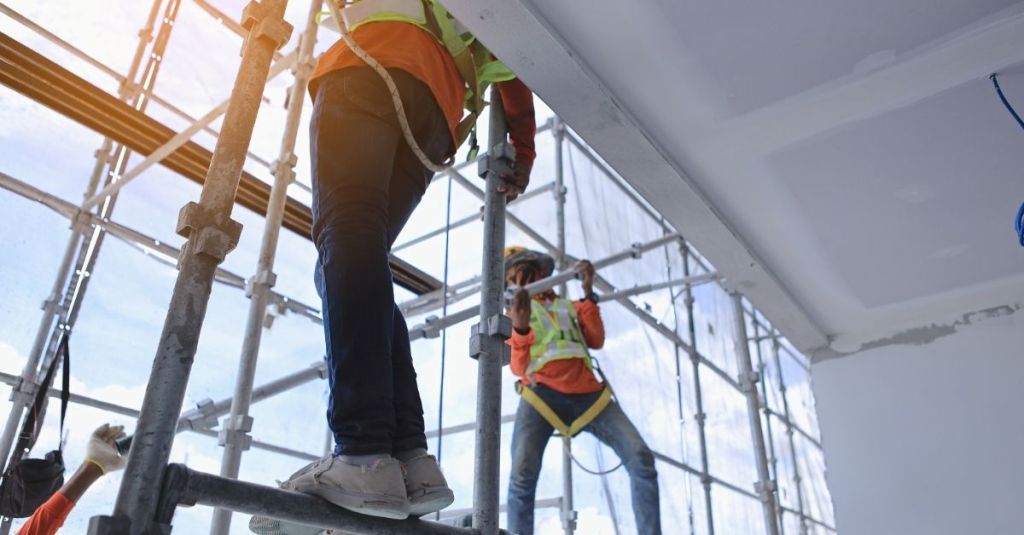
- Scaffolding
- Stays
- Slings
- Blocks
- Braces
- Ropes
- Hoists
- Ladders
- Hangers
- Pulleys
- Irons
The owners, contractors, and agents must construct, place, and operate these devices in ways that give proper protection to the workers.
If they fail to provide these devices, or the devices they provide fail in some way, and a worker is injured because of that, they are legally liable to the worker for damages.
Generally, the injury must result from the force of gravity– either the worker fell from a height (which scaffolding, ladders, and similar devices could prevent) or an object struck the worker from above (which hoists, pulleys, slings, and similar devices could prevent).
The damages for these injuries can range from hundreds of thousands to millions of dollars.
Section 241(6) applies where construction, excavation, or demolition work is being done. The owner, contractor, or agent must comply with New York State Labor Department regulations concerning the areas where this work is being done.
Specifically, the areas must be:
- Constructed
- Shored
- Equipped
- Guarded
- Arranged
- Operated
- Conducted
… In ways that provide reasonable & adequate protection & safety to workers in those areas and anyone else who is lawfully there. That could include construction workers and individuals employed in the building under construction.
If a worker is injured, and the direct cause of the injury was a violation of one of the regulations, the owner, contractor, or agent (such as a construction manager) is liable to the worker for damages.
If an injured worker sues them under either of these sections, owners, contractors, and agents are prohibited from arguing that:
- The worker knew the danger and took the job anyway (the New York State Legislature abolished that defense in 1910)
- The worker’s poor judgment contributed to the accident (the New York State Court of Appeals abolished that defense in 1948 in a case in which a worker was ordered to use a ladder he thought was dangerous)
Owners, contractors, and agents can win a lawsuit under Section 240(1) if they can prove:
- The work did not involve any of the listed activities (erection, demolition, repair, etc)
- The work did not require the use of one of the listed devices (that is, none of the devices would have made a difference)
- The work could have been done in a different way that was safer
- The worker had an appropriate safety device available, knew where it was, and knew that he or she was expected to use it
They can win a lawsuit under Section 241(6) if they can prove any of the following:
- The work did not involve construction, excavation or demolition
- The regulation was not violated
- A regulation was violated, but it did not apply to the work being done at the time of the accident
- The violation of the regulation was not the direct cause of the accident
Owners, contractors & agents cannot delegate these duties to others. However, they can transfer the
financial cost to others. This is usually done through liability insurance policies.
There are two techniques for transferring the cost of damages through liability insurance:
- Indemnification (or “hold = harmless”) agreements
- Additional insured coverage
The Workers’ Compensation Law prevents an injured worker from suing his employer, but he is allowed to sue the owner or contractor who hired his employer.
A hold harmless agreement requires the worker’s employer to pay for any damages the owner/contractor incurs as a result of the employer’s work on the project.
If an injured worker sues the owner or contractor, they pass the lawsuit to the employer. The employer must then pay the legal costs plus any damages. Normally, the employer submits a claim to its liability insurer.
The owner or contractor may also ask the employer to name them as an “additional insured” on the employer’s liability insurance policy. This makes them a customer of the employer’s liability insurer. If an injured worker sues them, they can send the claim directly to the insurance company. The insurer then must pay for the additional insured’s legal defense and any damages. Even though the owner or contractor is an insured, it is the employer that pays the premium for this insurance to its insurer.
Hold harmless agreements and additional insured coverage are not the same thing. With a hold harmless agreement, the owner or contractor makes a claim against the employer; it is a claimant. With additional insured coverage, they make claims directly to the insurer; they are insureds. Both protections may apply. An owner or contractor may be protected by both a hold harmless agreement in a contract and by additional insured coverage at the same time.
Conclusion
Many believe that the large cost of scaffold law claims increases liability insurance premiums for contractors in New York and makes that coverage harder to obtain.
These groups and individuals have urged the State Legislature to reform or repeal the law. However, the Legislature has not changed it since 1980.
Topics